
The Virginia Institute for Spaceflight & Autonomy (VISA) at Old Dominion University is exploring the potential of unmanned systems, such as drones and autonomous plows, to address transportation and logistical challenges. VISA will conduct two state-funded projects this year to study how unmanned systems could expedite the transport of goods, services, and travelers in Hampton Roads. The institute will also evaluate the potential economic impact of investing in autonomous systems with the help of ODU’s Dragas Center for Economic Analysis & Policy. VISA is additionally collaborating with the city of Norfolk and OpenSeas Technology Innovation Hub to create a test site for unmanned water vehicles, marking a significant development in the exploration of unmanned system possibilities.
Introduction
From ODU By Amber Kennedy
Exploring Potential with VISA
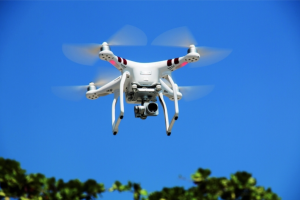 VISA is exploring ways drones, like this one from the AUVSI HR Autonomous Systems Demonstration Day, can address transportation and workforce challenges.
In early January, hundreds of drivers were stranded in snowy conditions on Interstate 95 for more than 24 hours. Some were low on gas. Some didn’t have food. All were stuck until the Virginia Department of Transportation (VDOT) could clear the blockages.
But what if drones could have delivered care packages to motorists? What if VDOT had the ability to deploy autonomous plows? What if transportation of goods and people wasn’t limited to the existing highways, railways and shipping routes?
These are the big “what ifs” being tackled by the Virginia Institute for Spaceflight & Autonomy (VISA) at Old Dominion University, launched in 2019 to explore the untapped potential for spaceflight and autonomous systems in Hampton Roads and the commonwealth.
Capitalizing on Hampton Roads’ Assets
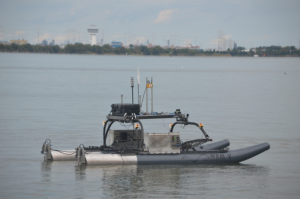 VISA and the OpenSeas Technology Innovation Hub are partnering with the city of Norfolk to create a testing site for unmanned water vehicles, similar to this one.
VISA is capitalizing on Hampton Roads’ strategic advantages. “The commonwealth and Southeast Virginia are blessed with unique assets for aerospace – two NASA facilities, a huge Department of Defense presence, a geographical ecosystem with both urban centers and rural areas, big inland bay ports and proximity to Washington, D.C.,” said David Bowles, executive director for VISA. “We’re looking to leverage those assets to grow the economy, develop talent and foster innovation.”
Reimagining Transportation
This year, VISA will work on two state-funded projects designed to imagine the possibilities for autonomous systems, such as air drones or waterborne vehicles, in Hampton Roads.
In December 2021, VISA received $100,000 from GO Virginia to conduct a study of air, ground and water routes to identify how unmanned systems could expedite the transport of goods, services and travelers. They’ll also work with ODU’s Dragas Center for Economic Analysis & Policy to evaluate the potential economic impact of investing in autonomous systems.
To conceptualize a future in which unmanned vehicles could bypass existing gridlock, VISA will convene focus groups including representatives from relevant industries, federal facilities, local government and the military.
Testing the Waters
VISA’s work is directly connected to ODU’s recently announced Maritime Initiative, emphasizing the University’s role as a leader in the region to build upon, leverage and coordinate maritime research and innovation. The effort will align the University’s existing resources confronting these issues, including VISA and the Institute for Innovation & Entrepreneurship (IIE) and its OpenSeas Technology Innovation Hub, focused on bringing partners in business, industry and government together to identify problems and clear the way for growth in the “blue economy.”
The report noted Hampton Roads has the potential to become a national hub for integrated autonomous systems, which could solve market needs for the Navy, offshore wind operations and activities related to the Port of Virginia.
Working closely with the city of Norfolk, VISA and OpenSeas will take an important step in that development with the renovation of a public boat ramp to become a test site for unmanned surface vehicles (USVs) and unmanned underwater vehicles (UUVs). Through the Port City Communities Revitalization grant program, the General Assembly allocated $394,000 for the city to renovate the nearly five-acre Willoughby Boat Ramp to create a dedicated testing area.
Question & Answer
1. What is the Virginia Institute for Spaceflight & Autonomy (VISA) exploring?
VISA is exploring the potential of unmanned systems, such as drones and autonomous plows, to address transportation and logistical challenges.
2. What projects will VISA conduct this year?
VISA will conduct two state-funded projects to study how unmanned systems could expedite the transport of goods, services, and travelers in Hampton Roads.
3. How is VISA collaborating with other entities to create a test site for unmanned water vehicles?
VISA is collaborating with the city of Norfolk and OpenSeas Technology Innovation Hub to create a test site for unmanned water vehicles, marking a significant development in the exploration of unmanned system possibilities.