
After losing her job due to COVID-19, Cindy R. Earl used her newfound time to care for her ailing grandmother, which inspired her to start a company dedicated to investigating elder abuse. However, she lacked the necessary skills to establish her business. This is where Old Dominion University’s Hudgins Transitional Entrepreneurship Lab stepped in. This lab, launched in 2019, is dedicated to educating and supporting potential entrepreneurs from marginalized communities, focusing on aiding women, minorities, veterans, immigrants, refugees and formerly incarcerated people. The lab provided Earl with the mentorship, support, and resources needed to turn her idea into reality, showcasing how community resources can contribute to entrepreneurship success.
Introduction
From Virginia Business M.J. MCATEER
When COVID-19 hit in the spring of 2020, Cindy R. Earl lost her job as a furniture company’s sales rep.
Cindy Earl’s Journey
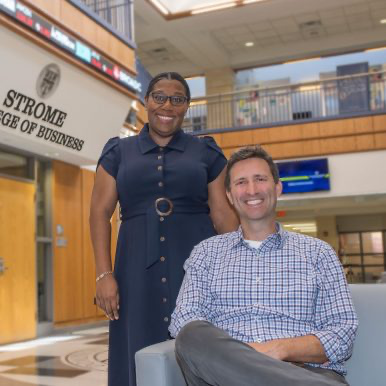 Cindy Earl, who started an eldercare private investigation company, is one of several participants at Old Dominion University’s Hudgins Transitional Entrepreneurship Lab. Jay O’Toole is its deputy director. Photo by Mark Rhodes[/caption>
But the Portsmouth resident’s sudden unemployment came with a positive side effect: She had time to assume care of her ailing grandmother after the pandemic had shuttered the assisted living facility where her grandmother had lived. It was an experience that turned out to be unexpectedly inspirational.
“I’m an inquisitive person,” Earl says, and seeing the problems that her grandmother had suffered as an Alzheimer’s patient, which included dehydration and an unexplained injury, made her want to start a company dedicated to investigating elder abuse. She didn’t really know how to go about doing that, however, and that’s where Old Dominion University’s Hudgins Transitional Entrepreneurship Lab came in.
Old Dominion University’s Hudgins Transitional Entrepreneurship Lab
Launched in 2019 with a $1.2 million gift from Marsha Hudgins, an ODU alumna who owns a construction company in Hampton, the academic research enterprise is dedicated to educating and supporting would-be entrepreneurs who live in underserved and marginalized communities in the Hampton Roads area. Its focus is on aiding women, minorities, veterans, immigrants, refugees and formerly incarcerated people.
“Entrepreneurial efforts have long provided much less resistance and more immediate reward for hard work and creativity for groups with no readily available opportunities in the business world,” Hudgins says, explaining why she, the granddaughter of Greek immigrants, wanted to provide a leg up to other prospective entrepreneurs. But, for the disadvantaged, hard work and creativity often are not enough to ensure success.
Support and Mentorship
According to a 2020 National Bureau of Economic Research study, Black entrepreneurs received an average of $35,205 in startup capital, compared with $106,720 for white entrepreneurs. And although venture capital for Black-owned startups doubled in 2021, according to Crunchbase, only 1.2% of all VC funding goes to Black entrepreneurs.
“Our mentees have the passion and the ideas,” says Hudgins Lab Director Robert J. Pidduck, also an assistant professor of entrepreneurship at ODU’s Strome College of Business.
“They are eager to get something off the ground,” he says, but they often lack the specific skills necessary to launch and sustain an enterprise — as well as the professional connections that make the wheels of commerce go ’round.
Community Resources and Growth
Financing can be a big sticking point, though Pidduck labels a sole focus on money as a distraction. “Throwing money at anyone doesn’t solve deeper problems,” such as lack of know-how and business contacts, he says.
To tackle those issues, the Norfolk entrepreneurship research lab draws on both academic assets and community resources.
During the height of the pandemic, the lab offered virtual panels, seminars, workshops and informal gatherings focusing on make-or-break subjects such as marketing, accounting and the use of crowdfunding to bypass possible racial bias in lending.
Question & Answer
1. How did Cindy R. Earl’s experience with her grandmother inspire her to start a company?
Seeing the problems her grandmother faced as an Alzheimer’s patient, including dehydration and unexplained injuries, inspired Cindy R. Earl to start a company dedicated to investigating elder abuse.
2. What role did Old Dominion University’s Hudgins Transitional Entrepreneurship Lab play in Cindy Earl’s entrepreneurial journey?
The lab provided Cindy Earl with the mentorship, support, and resources needed to turn her idea of investigating elder abuse into reality.
3. Who does the Hudgins Transitional Entrepreneurship Lab focus on supporting?
The lab focuses on aiding women, minorities, veterans, immigrants, refugees, and formerly incarcerated people from marginalized communities in the Hampton Roads area.