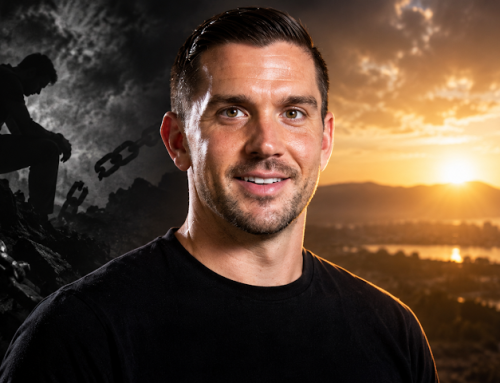

There are people who chase risk for the adrenaline, and there are people who learn to respect it. Jay Prock falls firmly into the second camp.
More than a decade ago, Prock had logged over 1,100 skydives. Competitive canopy piloting, known as swooping, was the highest-risk discipline in the sport.
“I misjudged my timing and my parabola looked more like smack,” he said. “I fortunately hit water instead of earth. At about fifty-five miles an hour, my body stopped, but all my organs kept going.”
The injuries were severe. Torn spleen. Internal bleeding. Emergency surgery. A week earlier, he and his wife had learned they were expecting their first child. The moment forced a reckoning, not just physically, but mentally.
“I was not about to let an accident or a problem for which I had caused and that I was responsible for define my career,” Prock said.

That mindset — accountability paired with restraint — would become the defining principle behind Tidewater Staffing, the second-generation workforce company he now leads in Hampton Roads.
Prock doesn’t reject risk. He studies it.
“Entrepreneurs and skydivers are kind of a similar breed,” he said. “But it’s a mentality thing. You take your licks, you learn your lessons, you retool, regear, and you get back at it.”
The difference, he learned, is knowing which risks are survivable — and which ones can destroy everything.
That philosophy runs through Tidewater Staffing’s operations. The company focuses exclusively on the Port of Virginia, resisting national expansion in favor of depth, control, and accountability. Every worker is employed as a W-2. Benefits begin on the first paycheck. Training, PPE, and safety systems are treated as non-negotiable.
“If you’re going to take extra risk for perceived reward,” Prock said, “you better understand what you’re willing to lose if something goes south. Don’t swoop into the pond.”
That discipline was earned, not inherited. Tidewater Staffing was founded by Prock’s father in 1992, but Prock was never fast-tracked into leadership. His entry into the business was slow, deliberate, and earned the hard way.
During the Great Recession, Prock worked trades jobs outside the company — laying tile, running insulation, plumbing, electrical work — gaining firsthand respect for the labor Tidewater Staffing would later support. When he returned to Hampton Roads in 2010, he didn’t step into an office role. He started at the bottom: fire watch, tank cleaning, recruiting.
In 2018, Prock and his sister officially bought the business. But the real transition happened years earlier, when his father made a decision that forced accountability.
“He stopped taking his cell phone onto the golf course,” Prock said. “For a few hours a day, I had no safety net. He let it go.”
Without immediate access to answers or approvals, Prock was forced to make decisions — and live with the outcomes. That stretch of autonomy shaped both his leadership style and the company Tidewater Staffing would become.
At its core, Tidewater Staffing operates closer to community infrastructure than a traditional staffing firm. The company routinely helps workers bridge gaps — a car battery, a short loan to make it to payday — small interventions made possible by staying local and disciplined.
“If we were growing for growth’s sake, we wouldn’t be able to do that,” Prock said.
The lesson Prock learned in the sky never left him. Leadership, like skydiving, isn’t about bravado. It’s about preparation, limits, and responsibility. Anyone can jump. The real challenge is building something that still stands after the landing.
And that comes down to one rule: know what you can afford to lose.
Catch the full conversation with Jay Prock on The Fervent Four Show, where he goes deeper on disciplined risk, leadership, and building Tidewater Staffing through the toughest moments.Watch here: https://youtu.be/6790Z1NB7tc
Learn how founders across the 757 have pushed through the toughest moments. Read their stories and subscribe to This Week in 757 for weekly insights from the region’s entrepreneurs.