
In many regions, founders are told explicitly or not that scale requires proximity to power. Bigger markets. Denser capital. Louder networks. The assumption is that opportunity concentrates elsewhere, and that leaving smaller ecosystems is a prerequisite for serious ambition. Yet across Hampton Roads, a quieter counter-pattern has been forming. Some founders are not staying because they have to. They are staying because the conditions allow them to move.
That tension between perceived scale and practical momentum has sharpened as early-stage companies weigh where support actually shows up. Capital is more distributed than it once was. Universities have expanded their role beyond education. Cities are learning how to engage founders earlier, even if imperfectly. What increasingly matters is not how many rooms exist, but whether someone opens the door.
Timing has played an outsized role in reshaping the region’s startup environment. Many of the resources founders now encounter, including grants, incubators, and public-private partnerships, either did not exist a decade ago or were concentrated elsewhere. Investment activity was often oriented toward Northern Virginia, leaving fewer pathways locally. What has emerged in its place is not abundance, but access. Fewer layers, shorter distances, and a higher likelihood that an early conversation leads somewhere tangible.
For some founders, that shift changes how they evaluate where to build.
Hannah LaCon did not arrive in Hampton with a long-term plan to stay. She came for school, enrolling at Hampton University, and expected, like many students from outside the region, to eventually move on. Instead, she built a company, stayed after graduation, and convinced her parents to relocate as well. “They love Hampton,” she says. “They love the city, they see a lot of opportunity for growth and they see exactly what I see.”
What she saw was not just affordability or convenience. It was alignment. “Sometimes it’s just better to get out of your environment,” LaCon says. “When people are already familiar with who you are and they see you one way, it’s hard to push past some limiting beliefs.” Starting somewhere new created space, she explains, “so you can kind of like challenge yourself but also grow into who you’re meant to be.”
That decision shaped how she approached building HerculE-Q, a technology infrastructure company focused on wireless charging for electric micromobility vehicles. The idea did not start with speculation about future behavior, but with observation. “Those are, think, your e-bikes, your e-scooters, or electric wheelchairs,” LaCon says. “Those vehicles are being used more and more every single day.”
What is missing, she argues, is infrastructure. “Right now, essentially, there is really no charging infrastructure for those type of vehicles.” In the absence of fixed charging, scooters are left on sidewalks and corners, and companies rely on labor-intensive charging models. “They’ll have people pick up their scooters, take them to the warehouse, or get the batteries from the warehouses and swap them out,” she says. “Which is expensive.”
LaCon’s approach is deliberately incremental. Universities first, followed by cities and municipalities. Pilots before scale. Safety, certification, and manufacturing before speed. “There’s a lot of safety testing, getting certifications, manufacturing,” she says, noting a projected 24-month timeline before early deployments. It is a long bet on inevitability rather than urgency. Asked whether micromobility is here to stay, she answers simply. “Oh yeah. They for sure are still going to be a thing.”
That confidence is paired with a clear sense of belonging. “I try not to see myself as like a victim or anything like that,” LaCon says. “If I am invited into a room, if I have an idea, like, it’s just, I belong there.” Support, she adds, has often followed that posture. “Other people have seen something in me that I didn’t even know I had.”
She credits the region for reinforcing that belief. “The support that I’ve been given from Hampton, I just don’t think that I would get the same support if I was back in Jersey,” LaCon says. “It’s just a totally different ecosystem out there.”
Hampton Roads does not remove friction from the process. Cities still move slowly. Institutions still require patience. But for founders evaluating where momentum is possible, the region increasingly offers something harder to quantify than scale. Proximity to decision-makers, visibility at an early stage, and the space to grow without being predefined.
For LaCon, that environment has been enough to stay, build, and place a long-term bet. Not on where opportunity is supposed to live, but on where it is already beginning to move.
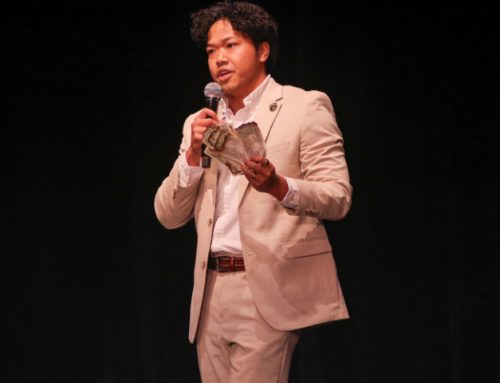
HerculE-Q is also part of REaKTOR, Hampton’s business incubator, where LaCon has continued to refine the company alongside other early-stage founders. In 2025, she pitched HerculE-Q at the Startup World Cup Virginia Regional Final, placing the company on a global stage while still building from Hampton Roads.