
A retired passenger jet is getting a second life at NASA Langley, carrying forward decades of aviation innovation developed in Hampton.
Inside a decades-old hangar at NASA’s Langley Research Center in Hampton sits a Boeing 777 that once carried commercial airline passengers around the world.
Its next assignment is far more ambitious.
The aircraft is being transformed into NASA’s largest flying laboratory, capable of spending up to 18 hours in the sky while carrying scientists and instruments designed to investigate Earth’s atmosphere, extreme weather and environmental changes.
It’s a remarkable second life for an aircraft that spent years in commercial service before NASA acquired it in 2022.
But the bigger story stretches back decades, long before this particular plane was built.
Some of the technology that made the Boeing 777 possible was pioneered at NASA Langley. Now, the aircraft has returned to Hampton to help advance the next generation of scientific discovery.
From Passenger Jet to Flying Laboratory
NASA’s Boeing 777 wasn’t built for scientific research.
Manufactured in 2003, the aircraft was originally designed to transport passengers across long distances. NASA acquired it in 2022 as part of a plan to replace its aging DC-8 flying laboratory, which had operated out of California and supported nearly four decades of Earth science research before retiring in 2024.
Rather than purchase an entirely new aircraft, NASA began transforming the existing 777 into something altogether different.
The conversion required far more than removing passenger seats.
Beginning in January 2025, the aircraft underwent extensive structural modifications at an L3Harris Technologies facility in Waco, Texas. Engineers redesigned portions of the aircraft to accommodate scientific equipment, adding specialized research stations, extensive wiring, enlarged windows and openings in the fuselage for instruments that observe the Earth below.
Nearly 35,000 precision holes were drilled into the aircraft’s underside as part of the structural modification work.
The result is a commercial airliner being rebuilt around an entirely different mission.
Instead of carrying luggage and passengers between airports, the aircraft will carry sophisticated sensors, researchers and the equipment necessary to conduct experiments thousands of feet above the planet.
NASA says the 777 will accommodate between 50 and 100 onboard operators and carry up to 75,000 pounds of equipment. Its flight duration can reach 18 hours, depending on the payload and weather conditions.
The aircraft returned to Hampton on April 22, 2026, following its major structural modifications in Texas. NASA and HII have also been responsible for research station and wiring upgrades inside the cabin.
It’s a massive undertaking, but one designed to provide scientists with capabilities that were not available on the aircraft it replaces.
Why Scientists Need a Plane This Big
NASA is best known for rockets, astronauts and spacecraft traveling millions of miles beyond Earth.
Yet some of its most important scientific discoveries happen much closer to home.
Satellites can observe enormous sections of the planet from orbit, but researchers also need measurements taken directly inside the atmosphere to understand and validate what those satellites are seeing.
That’s where the Boeing 777 comes in.
The aircraft can carry instruments that measure atmospheric conditions, study clouds and aerosols, observe the Earth’s surface and collect data that improves weather and climate models.
It will also help researchers calibrate satellite sensors and validate their observations, connecting measurements taken in space with information gathered much closer to the ground.
Unlike a satellite following a predetermined orbit, an aircraft can be directed toward particular weather systems or geographic regions and carry multiple experiments during the same mission.
Its substantial size allows larger scientific teams and more instruments to work together, while its long range makes it possible to investigate atmospheric systems across oceans and continents.
Those measurements matter far beyond the scientific community.
Better atmospheric observations can improve our understanding of dangerous storms, changing environmental conditions and the processes that influence weather around the globe.
Its First Mission Will Chase Dangerous Winter Weather
The Boeing 777’s first major scientific campaign is planned for early 2027.
Known as NURTURE, the mission will investigate the atmospheric processes responsible for high-impact winter weather, including extreme cold, powerful windstorms, snow, ice and hazardous ocean conditions.
The research will take NASA scientists across portions of North America, Greenland, Europe, the North Atlantic and the Arctic.
The objective is to better understand how atmospheric disturbances develop and evolve before producing dangerous weather.
NASA’s mission planning includes measurements taken thousands of miles from where a storm may eventually cause damage.
By studying those systems earlier, researchers hope to improve the science used to predict severe weather and understand how these events develop.
The project also demonstrates why the 777’s size and endurance are valuable.
It takes substantial fuel, specialized instruments and a large scientific team to conduct these observations over remote regions of the planet.
With the 777, NASA will have a platform built to undertake that work for years to come.
The Technology Behind Its Wings Began in Hampton
There’s another connection between this aircraft and Hampton Roads that makes its arrival particularly significant.
The history of the Boeing 777’s wing can be traced directly to research conducted at NASA Langley.
During the late 1960s, NASA engineer Richard Whitcomb began experimenting with an unconventional aircraft wing design.
At the time, conventional wing shapes encountered aerodynamic challenges as aircraft approached the speed of sound, creating drag and limiting efficiency.
Whitcomb developed what became known as the supercritical airfoil, a wing shape with a flatter upper surface and a carefully curved underside.
The design helped reduce drag and improve aircraft efficiency.
His research, developed and tested at Langley, eventually influenced the design of modern commercial aircraft around the world.
Boeing incorporated supercritical wing principles into aircraft including the 767 and 777. The technology helped make long-distance commercial flight more efficient and contributed to substantial fuel savings throughout the aviation industry.
That legacy is now visible inside NASA Langley’s own hangar.
An aircraft whose wing design draws from innovations developed in Hampton has returned to the same research center to support an entirely new generation of aerospace science.
It’s an example of how scientific discoveries can evolve into practical technologies, transform global industries and eventually create opportunities for entirely new research.
What the Boeing 777 Means for Hampton Roads
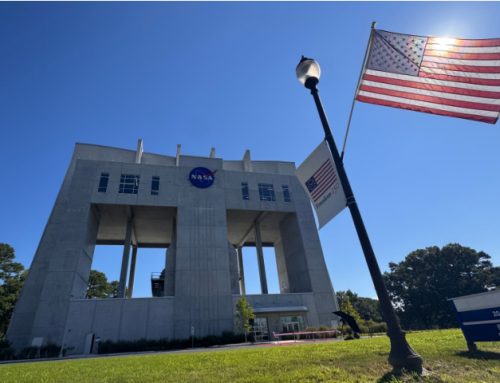
On October 15, representatives from Innovate Hampton Roads visited NASA Langley for an up-close look at the aircraft and its transformation.
The visit offered another perspective on the scale of research and engineering work taking place within the region.
For Hampton Roads, NASA Langley is more than a historic federal research facility.
It’s an institution whose research has influenced global aviation for generations and continues to bring advanced engineering, aerospace technology and scientific work into the region.
The Boeing 777 adds another significant capability to that ecosystem.
Its ongoing operations will involve researchers, engineers, aviation specialists, instrument developers and technical partners working across multiple disciplines.
The aircraft’s transformation already involves major industry partners, including L3Harris, Yulista and HII, demonstrating the complexity of the expertise required to support a platform of this magnitude.
Its presence also complements other investments taking place at Langley, including the center’s recently opened new wind tunnel and its partnership with Embry-Riddle to advance aerospace research and collaboration.
Together, these efforts reinforce Hampton Roads’ role in developing, testing and applying technologies with global significance.
The aircraft itself is an illustration of how that process works.
More than half a century ago, researchers in Hampton were developing wing designs that would reshape commercial aviation.
Today, one of the aircraft influenced by that work sits at Langley, being prepared to investigate the atmosphere, strengthen scientific understanding and improve the information used to study Earth’s most challenging weather systems.
The Boeing 777’s next chapter will take it around the world. But the technology behind its wings, and the research driving its future, lead right back to Hampton Roads.